|
A gorgeous dark relative to Nepenthes truncata, this Nepenthes robcantleyi boasts huge, flaring pitchers, a confusing lineage, and a dramatic discovery story!
|
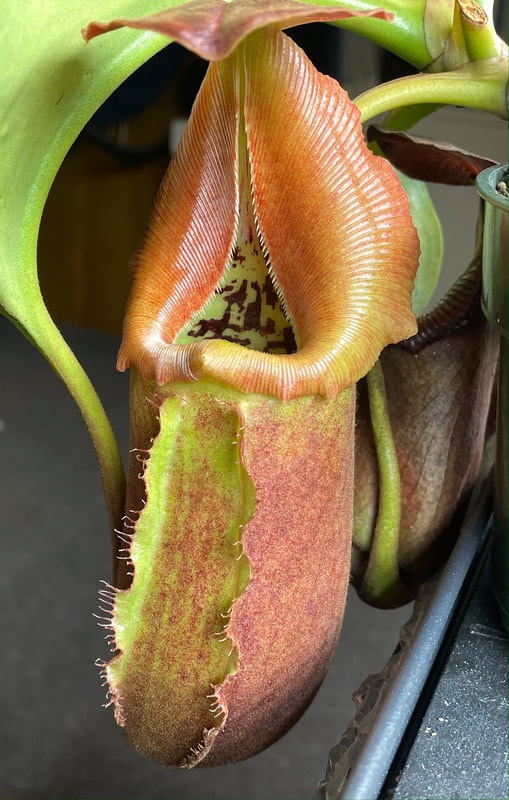
Newest pitcher going through its "orange" phase! February 2021
|
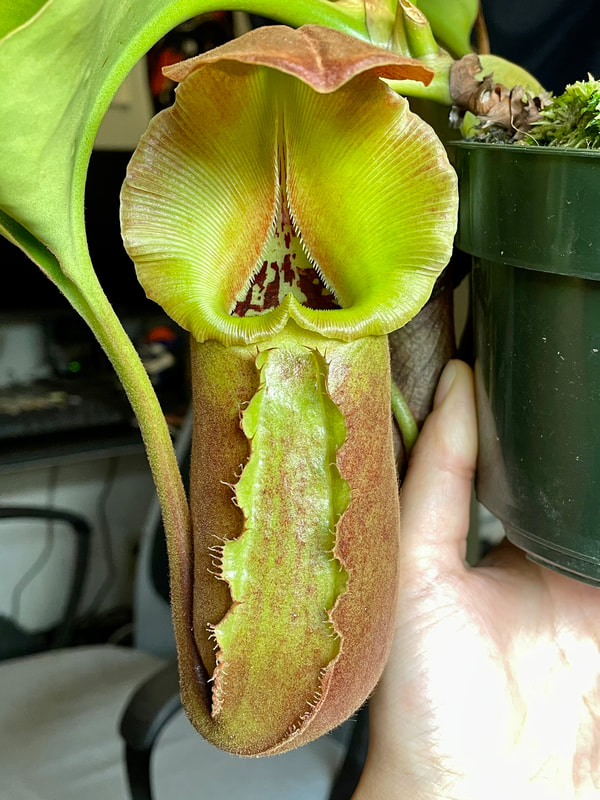
New pitchers start our a bright green! Also loving the wavy wings! February 2021
|
Nepenthes robcantleyi has one of the most complicated taxonomic histories out of all the Nepenthes! Below is the original account of the finding and subsequent cultivation of this species by Borneo Exotics.
|
"Some time back we bred two of the only nine plants known in cultivation of this, one of the rarest of all Nepenthes. The area where seed that gave rise to the original nine plants was collected was devastated by logging activities in the late 1990s and Nepenthes robcantleyi is believed to be either critically endangered, or possibly even extinct in the wild. The female parent of this release has the cultivar name ‘Queen of Hearts’, and is very probably the most photographed Nepenthes in history, having appeared on many of our gold medal winning Chelsea Flower show exhibits. The male parent named ‘King of Spades’ is darker in overall colouration than the ‘Queen of Hearts’ and has green peristome wings.
For some years we labelled these plants as a form of Nepenthes truncata, although there were clearly striking taxonomical differences between them and the existing published description of Nepenthes truncata. In December 2011 Nepenthes robcantleyi was described in the Nordic Journal of Botany as a distinct species in its own right by Dr. Martin Cheek, a taxonomist with the Royal Botanic Gardens at Kew. The publication gives the history of this species in cultivation and the reason why the name Nepenthes robcantleyi was chosen. Some differences in pitcher colouration, morphology, plant vigour and size when mature, can be expected to appear between individuals, but so far we are seeing good uniformity amongst these plants which are all raised from a single grex of seeds." |
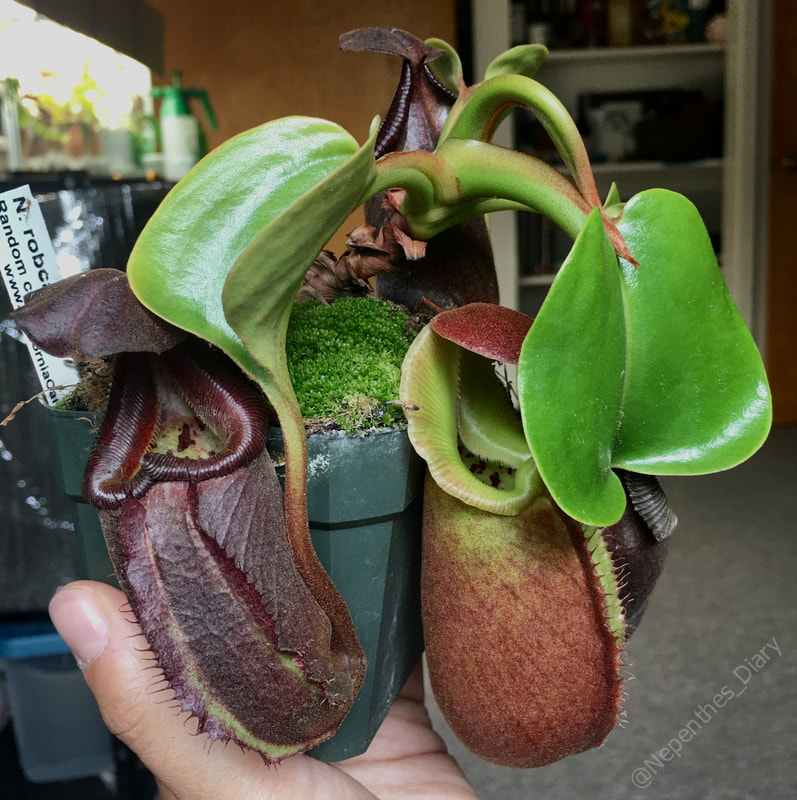
Love the contrast between new and old pitchers! This new one is shy and hiding under its leaf. September 2020
|
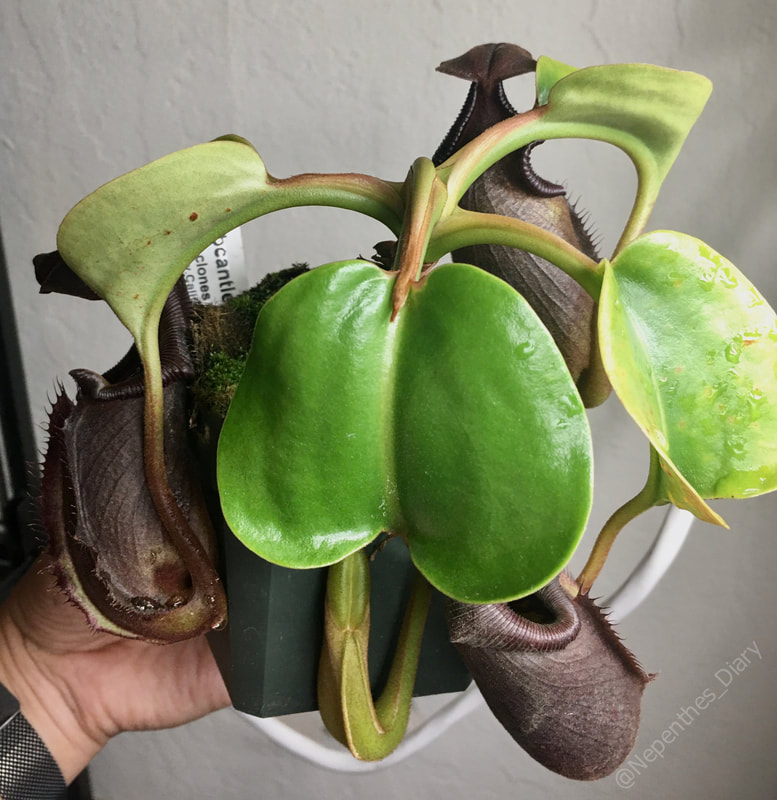
Love the compact, heart-shaped leaves, very similar to truncata! September 2020
|
Controversy still exists on whether this plant is its own species, or rather a natural hybrid between truncata, veitchii, or even nebularum, a recent discovery in and of itself! In the June 2017 Carnivorous Plant Newsletter, Geoff Mansell of Exotica Plants and Wally Suarez contend that the few original plants introduced into cultivation by Borneo Exotics were actually naturally occurring hybrids and should instead be termed Nepenthes x robcantleyi. The wide variation of F2 offspring from the plants in the original seedset points to the results of hybridization rather than the offspring of pure species. They provide evidence that Nepenthes robcantleyi could indeed be a cross between truncata and the newly described Nepenthes nebularum, which has been observed in the wild at multiple sites and different stages of growth. The true parentage of the original 9 N. robcantleyi recovered from the original site may never be validated because of the subsequent immediate destruction of its habitat due to logging!
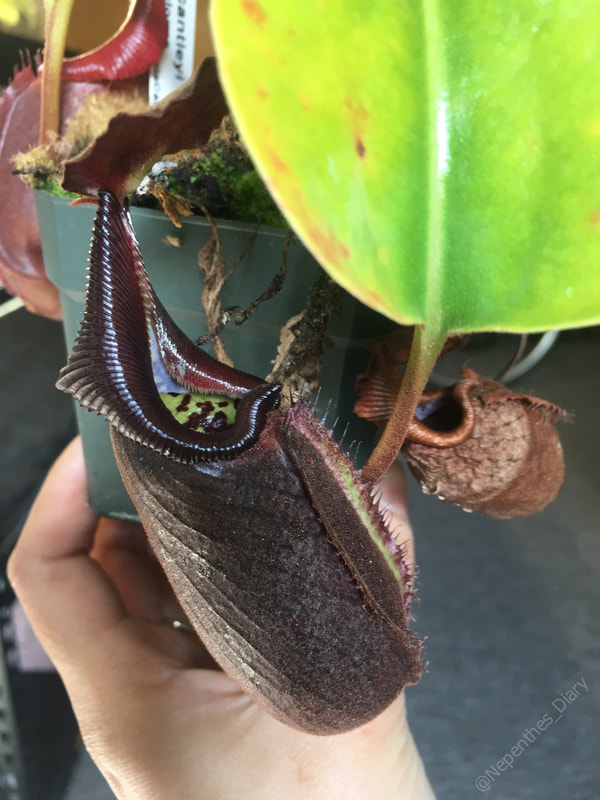
LOVE the color of the mature pitchers! April 2020
|
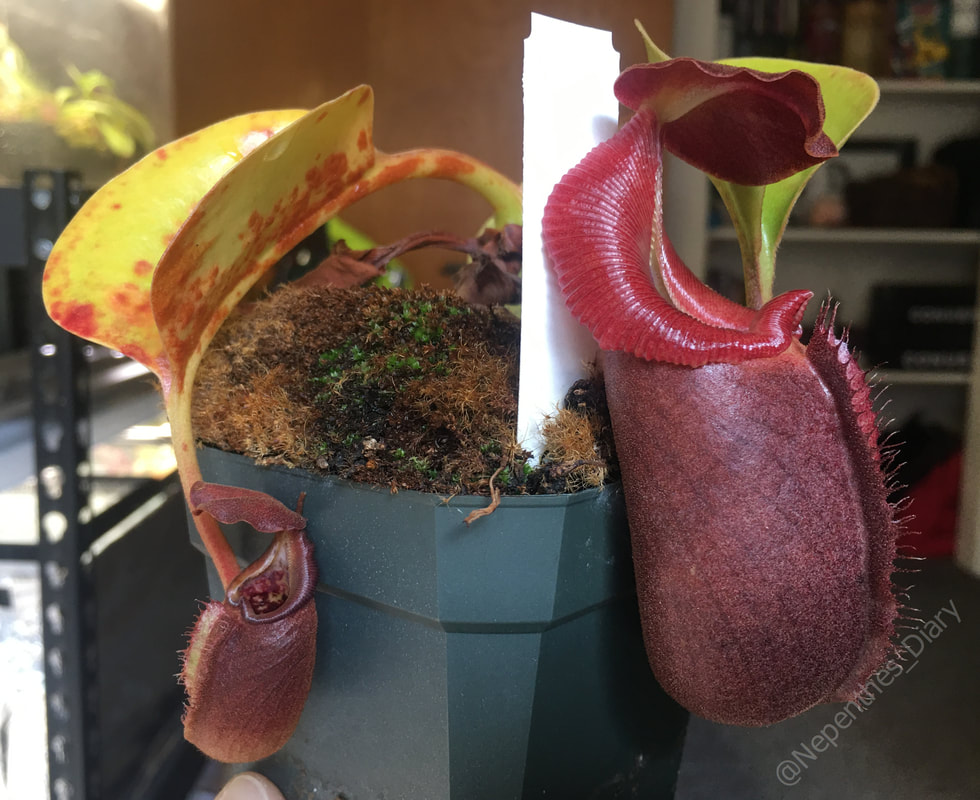
Talk about a jump in pitcher size! Notice the odema on the underside of the old leaf. April 2020
|
|
From Borneo Exotics on BE-3517: "So far as we aware, all of the 550 clones are remarkably true to form and all exhibit the dark colouration, that seems to be an invariable characteristic of the species. We have noticed only small variations in morphology, with some clones producing pitchers that are more squat than others."
|
I purchased my Nepenthes robcantleyi from California Carnivores at some point during 2018. I remember walking down the aisle and then seeing this little one sitting on the bench - I was SO EXCITED! It has always been an easy grower for me, although I have heard from some that it can be picky and temperamental. Perhaps it depends which clone? Borneo Exotics released a set of 550 "random clones" and I definitely think there can be variations in vigor between them (especially if 'Queen of Hearts' and 'King of Spades' are actually hybrids!). Mine is a solid little tank of a plant, somewhat slower growing than my other truncata but holds its beautiful dark pitchers FOREVER!
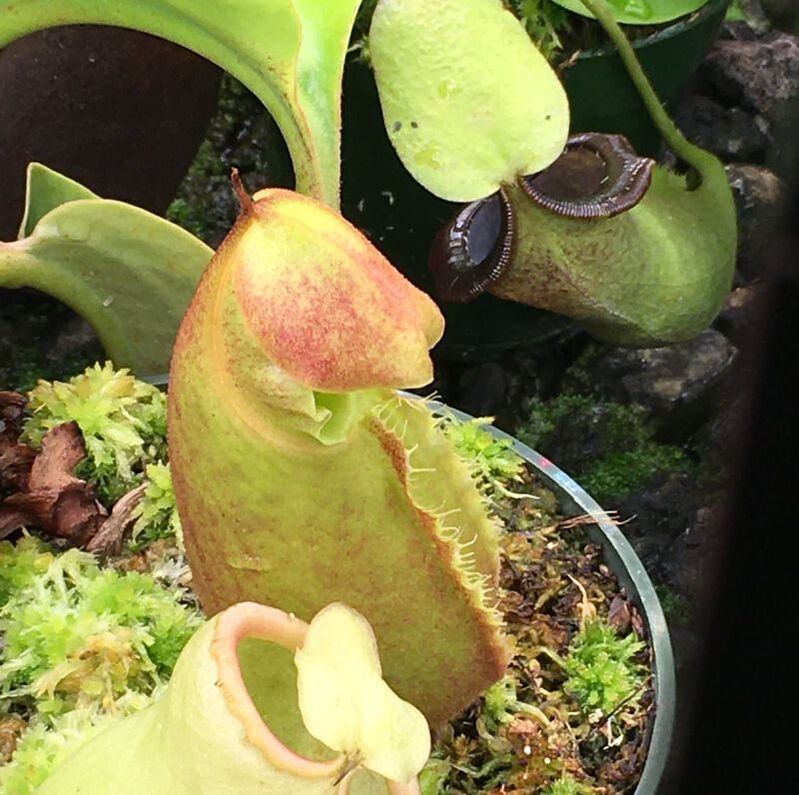
New pitcher just opening! November 2020
|
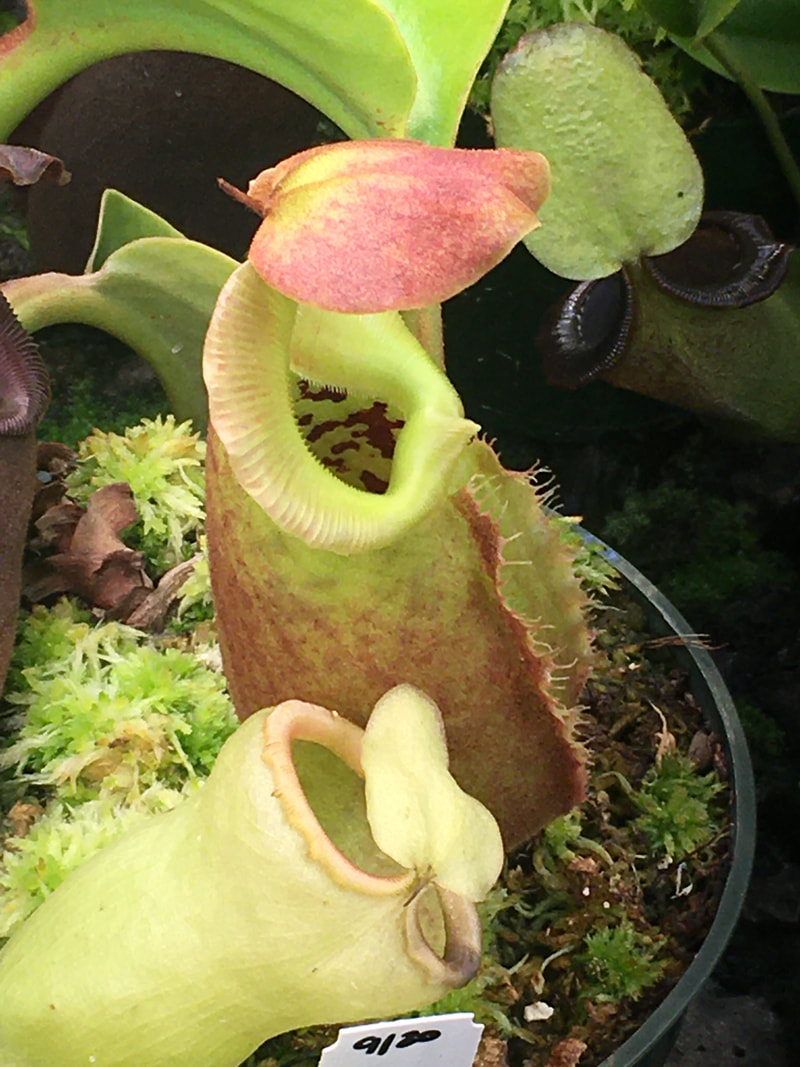
Little more color... November 2020
|
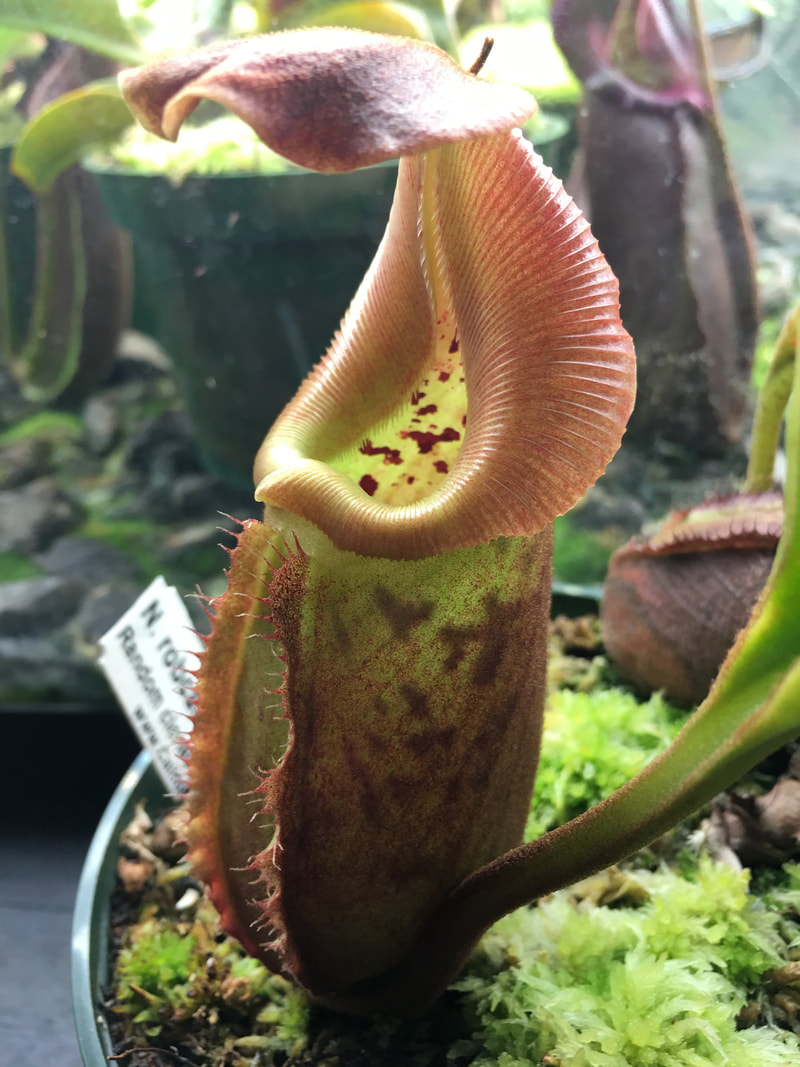
I love the lime greens and pinks! November 2020
|
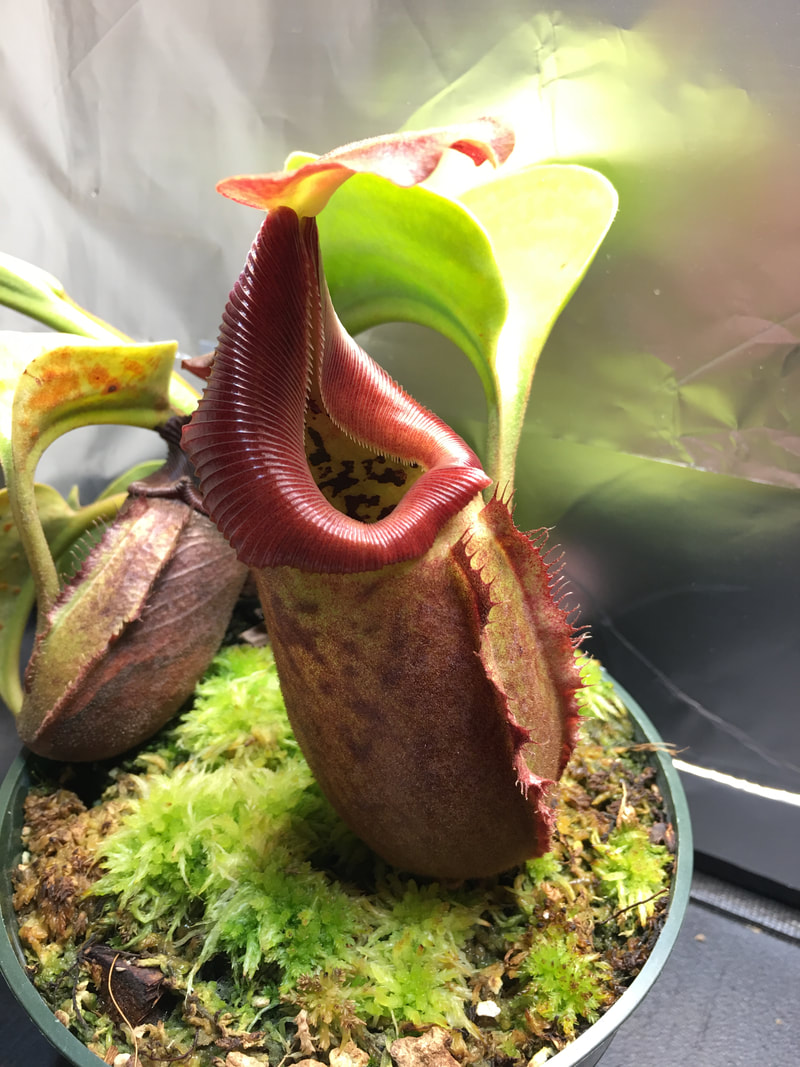
Almost there! Starting to redden up. November 2020
|
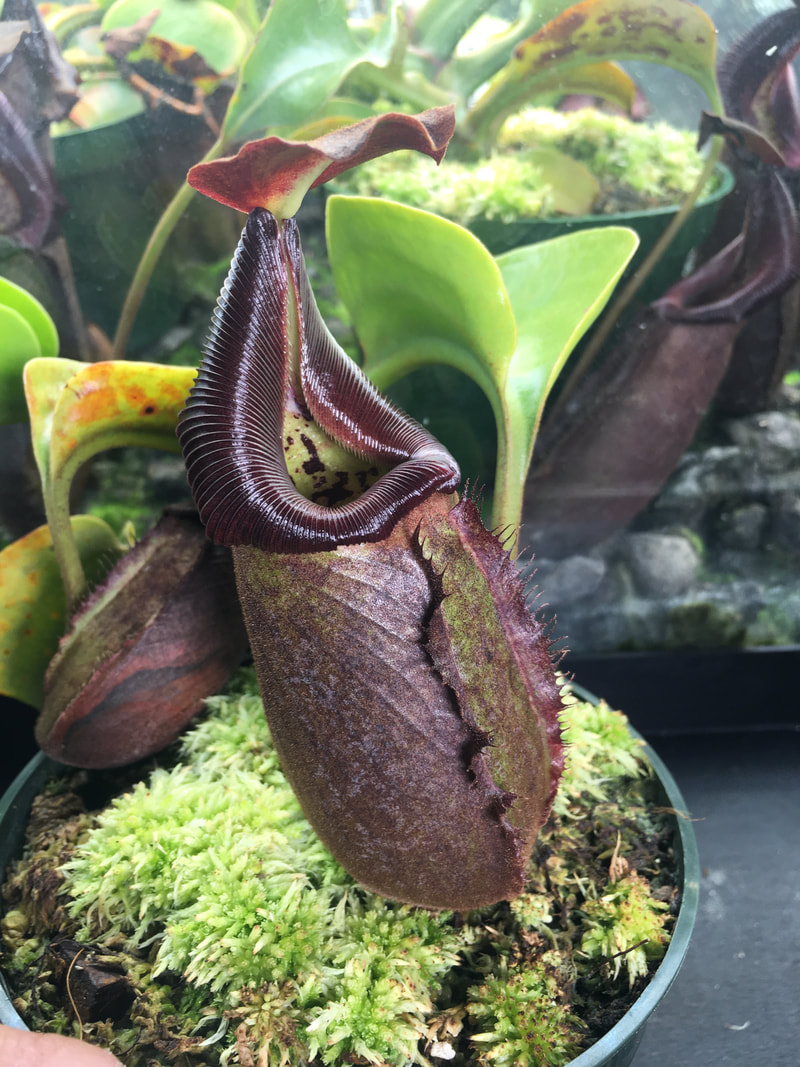
Final coloration is a gorgeous maroon/black! December 2020
|
One quirk I have discovered is that mine seems to be more sensitive to overwatering and develops ugly bursts of odema on the undersides of the leaves if I keep it too wet for too long (see above picture). Another thing I find interesting is that my young plant loves to shove its tendrils and developing pitchers as close to the pot as possible, often hiding its pitchers under its own leaves! This characteristic seems to be shared with most young truncata and other growers have commented that this improves trapping of ground-dwelling insects. It does make it a little annoying to photograph the pitchers.
October 2022
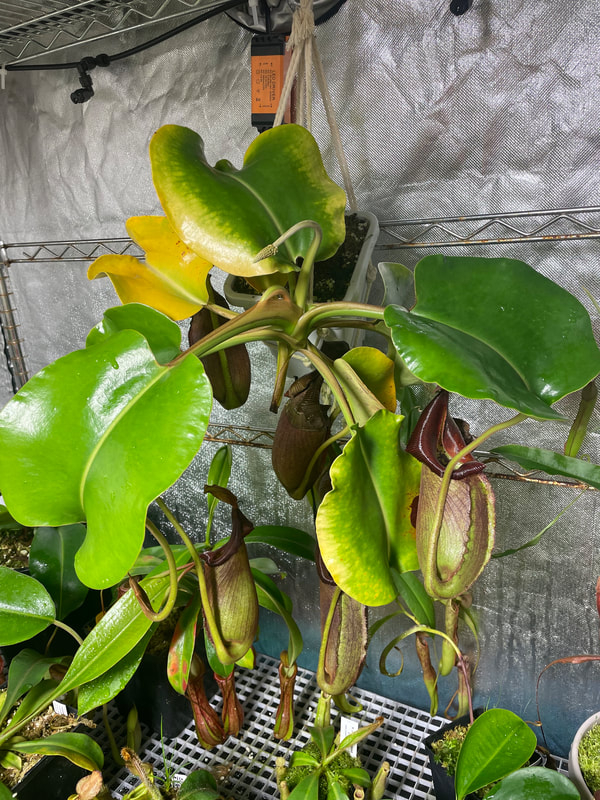
I LOVE the leaves on this plant! Big apple-shaped leaves with a strong, curved mid-rib.
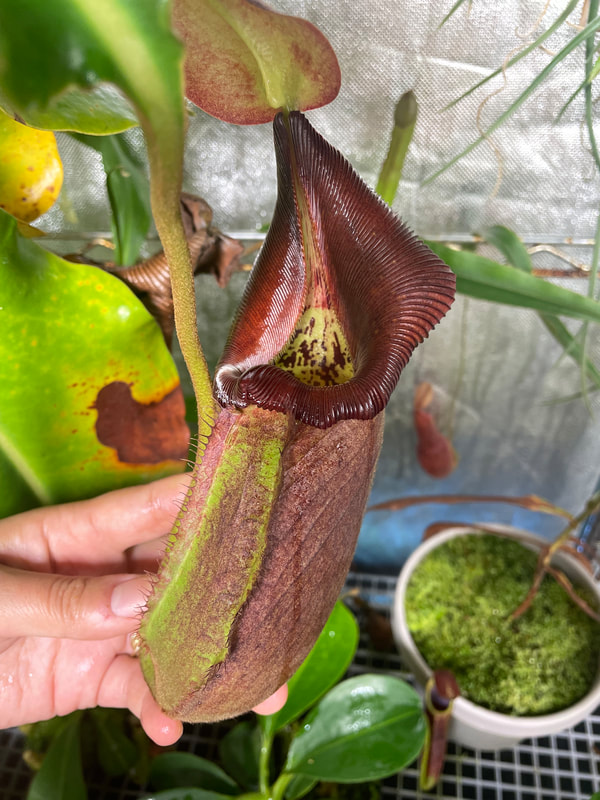
Notice the annoying fungal growth on the older leaf in the background
|
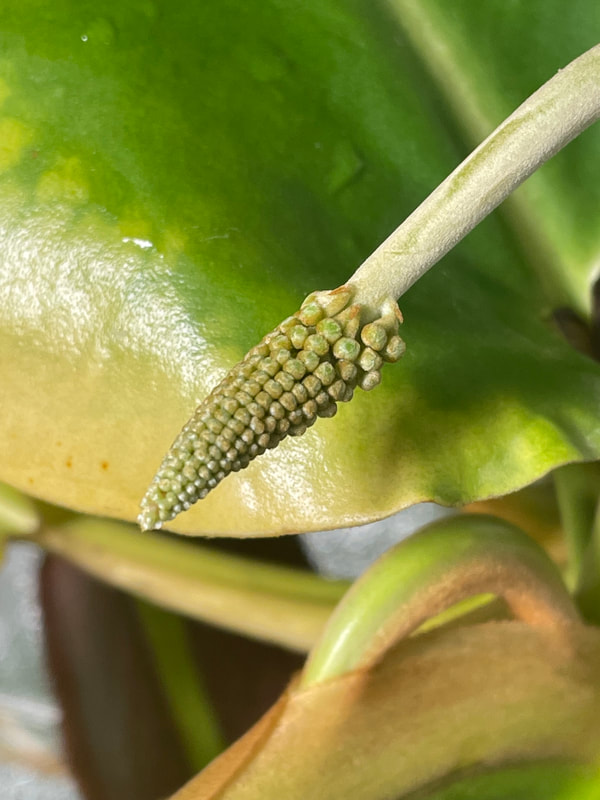
It's a boy!
|
Even though robcantleyi has definitely been one of THE pickiest plants in my entire collection, it is definitely one of my favorites. As this plant grows older, it seems to become more sensitive to overwatering and instability in humidity or temperature. I eventually graduated it to a hanging pot since it kept falling off the shelf - the intense sideways growth makes keeping it upright challenging! Despite all this, the lovely dark pitchers with their extravagantly flared peristomes always make me smile.
February 2023
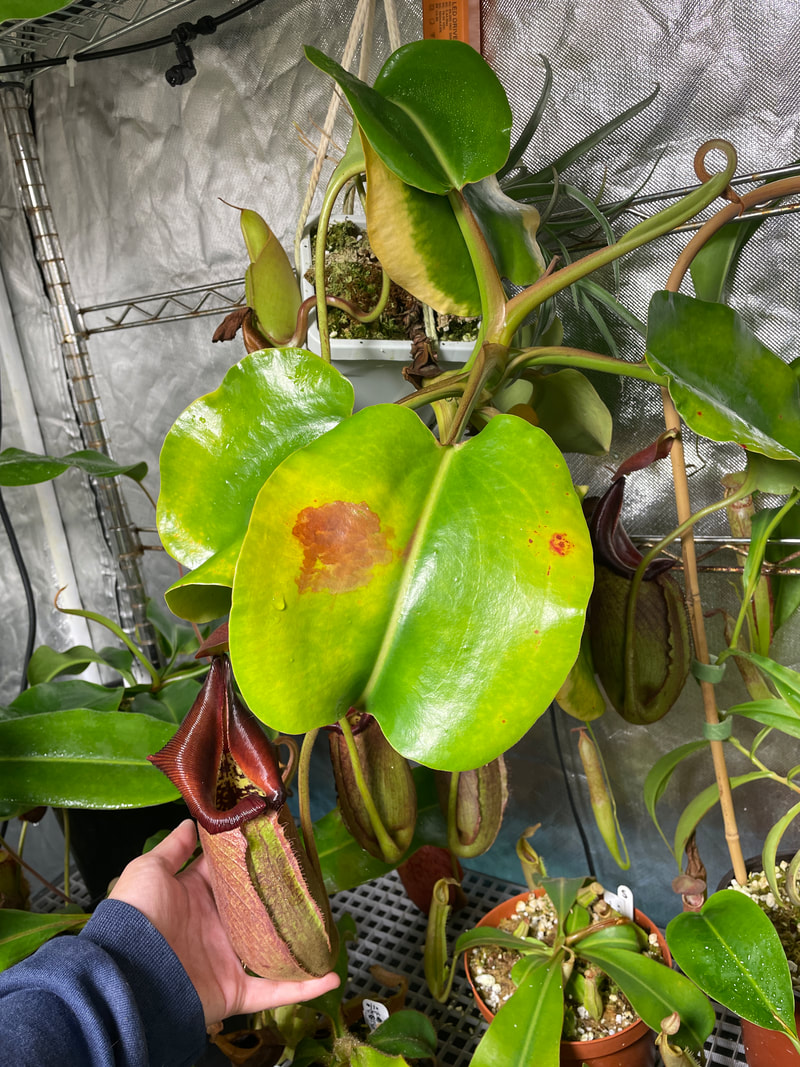
ARGH the blight!
|
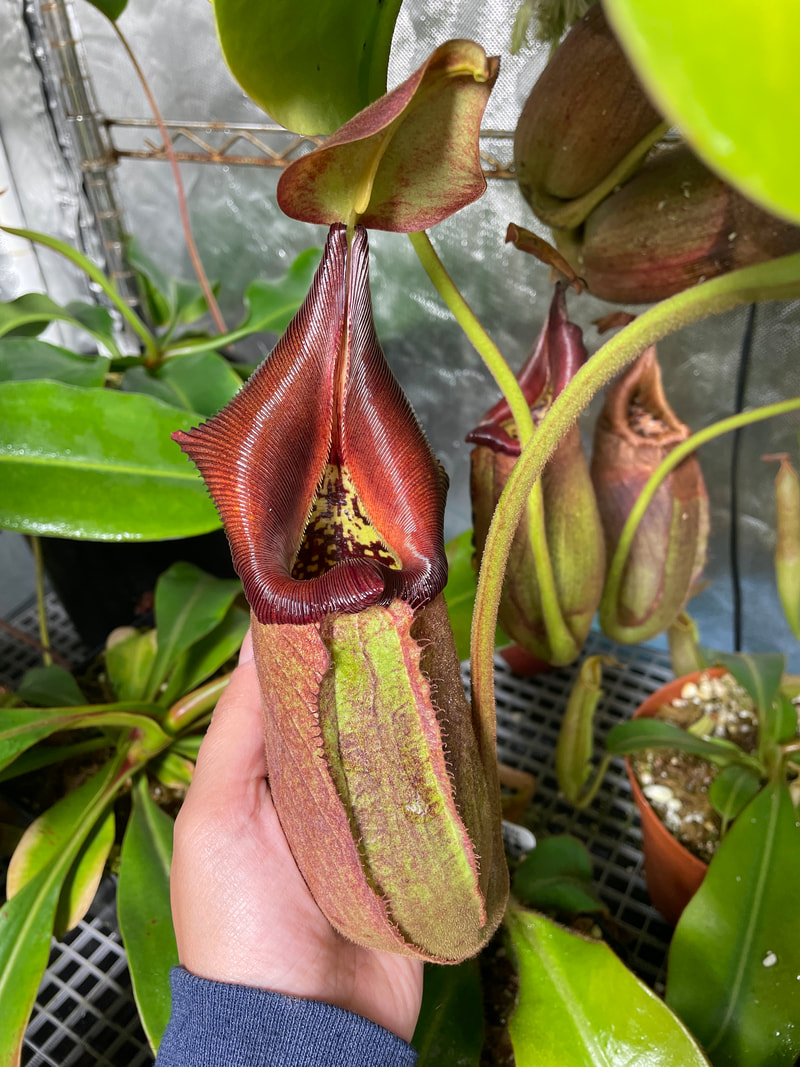
At least the pitchers are great :)
|
The frustrating thing about robcantleyi is that it can develop beautiful big apple shaped leaves for months and then - BAM! - a fungal attack will mar the leaves! Despite being in a hanging pot and letting it dry out between waterings, I think this recent attack came from shortening the photoperiod and increasing the humidity while I was traveling for 3 weeks, during which my dear non-plant friend came in and watered my plants once a week. The increased damp and lower temperatures probably allowed this recent attack to bloom on the leaf. However, the pitchers still look great! It's always nice to come home to a beautiful fresh pitcher!
|
Current Growing Conditions:
Intermediate/Highland Grow Tent Light: Mars Hydro TSL 2000 LED Grow Light Humidity: ~95-100% constant Temperature: ~60F night and 80F day Water: EXTREMELY SENSITIVE to overwatering! Let it dry out to almost bone-dry between waterings! Potting Mix: 50% long fibered sphagnum moss 50% perlite Fertilizer: MaxSea (1/4 tsp/gallon) every other week into pitchers and lightly spray leaves Additional Notes: This individual grows well in warm intermediate/highland conditions, however individual results may vary due to genetic variation. Young plants like to shove tendrils underneath own leaves and press on pots/benches. Older plants tend to grow sideways out of the pot and may need hanging. |

|