|
N. x Dyeriana is a living piece of Nepenthes history! Created by famous early Nepenthes growers in the Victorian era, it is one of the earliest complex hybrids in cultivation.
|
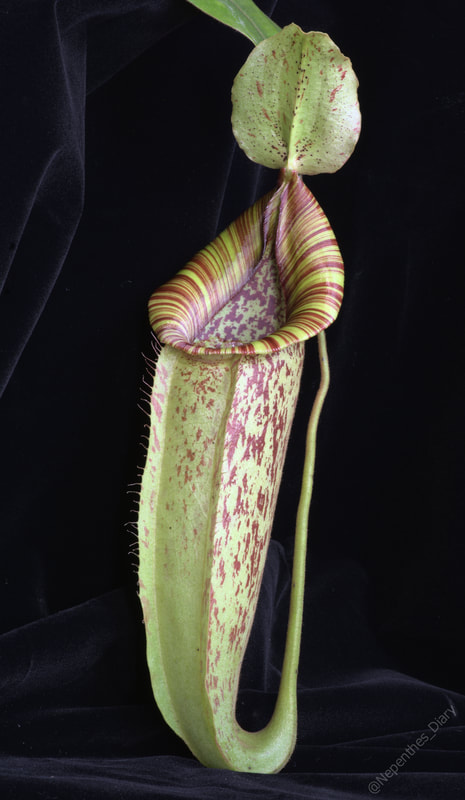
Nepenthes x Dyeriana in all of its splendor
|
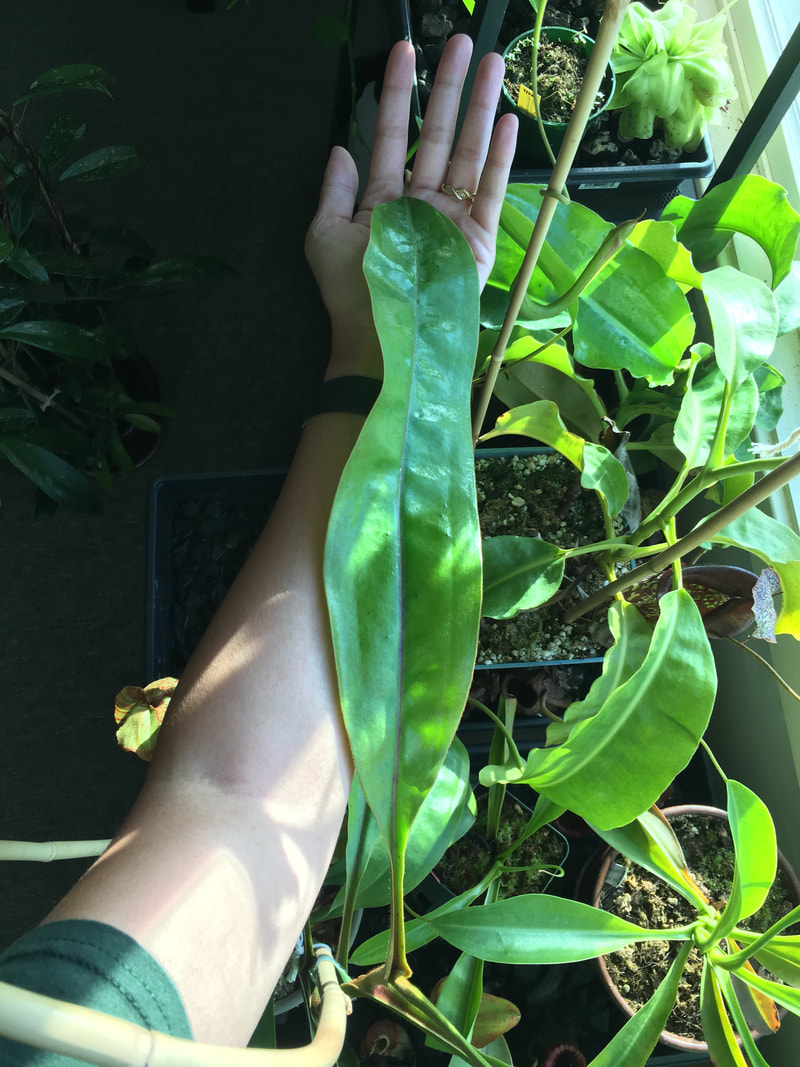
Each leaf is longer than my forearm!
|
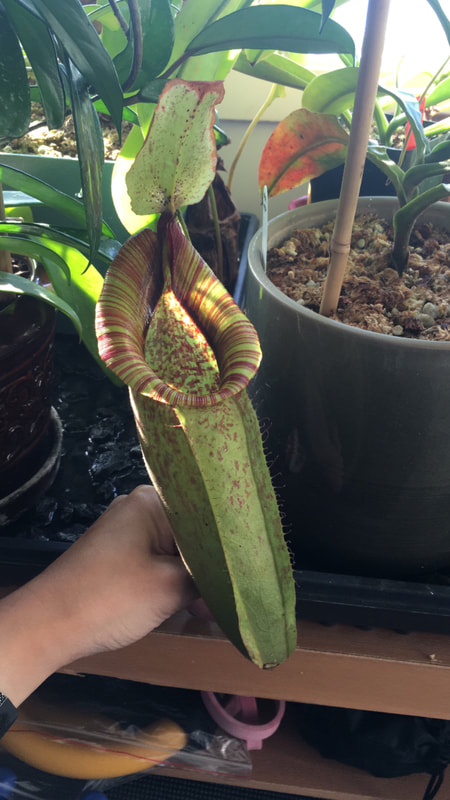
Adding humidity trays helps the thin-walled pitchers last longer in the living room!
|
Nepenthes x Dyeriana is a truly unique specimen. A complex hybrid of N. mixta x N. dicksoniana, both of which are their own classic Victorian hybrids, making the full name N. x Dyeriana (northiana x curtisii) x (rafflesiana x veitchii)! As far as I can tell, all N. x Dyeriana plants are descended from a single male cultivar produced during the Victorian era by George Tivey. During this time Nepenthes were just entering cultivation. Glass greenhouses were widely available for the first time due to recent technological advances in glass and heating, making them cheap to build and maintain. Newly discovered exotic plants were finally able to survive transoceanic voyages back to the Great Britain using glass Wardian cases. Victorians were PLANT CRAZY and couldn't get enough of these strange and beautiful tropical pitcher plants! To fuel the demand, Veitch Nurseries started hybridizing these newly imported species and made them available to the public.
Here is the first published account (written word for word) of N. x Dyeriana, in the 1900 Gardeners' Chronicle.
Here is the first published account (written word for word) of N. x Dyeriana, in the 1900 Gardeners' Chronicle.
NEPENTHES "SIR WILLIAM THISELTON DYER"
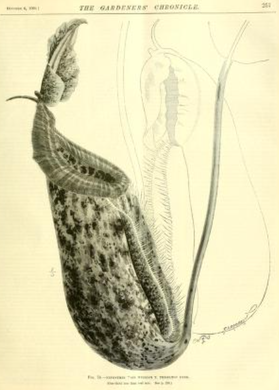
Original drawing and description of Nepenthes "Sir William Thiselton Dyer" in the 1900 Gardener's Chronicle. The characteristic striped peristome and hump-like process at the base of the lid are visible. Interestingly, this illustration is of a lower pitcher - most surviving N x Dyeriana produce only upper pitchers and very rarely produce basal shoots and lower pitchers.
|
With the exception of N. Northiae (Gardeners' Chronicle, 1881, p. 717, fig.144), this is the finest Nepenthes yet introduced into our gardens. It was raised in the nurseries of Messers. James Veitch & Sons, exhibited by them at a recent meeting of the Royal Horticultural Society, and named by them in compliment to Sir William T. Thiselton Dyer, the Director of Kew. Not the least of his works at the Kew has been the erection of a Nepenthes house, so that the dedication of this fine variety to him is specially appropriate. When one considers the ancestry of this fine form, there is no room for surprise at its merits. It was raised as a cross out of N. mixta x by N. Dicksoniana x, both fine varieties, and figured in these columns (see 1888. iv., 543, fig. 78). N. Dicksoniana x was raised out of N. Vetichi, by pollen of N. Rafflesiana and Curtisii. The general appearance of the pitchers is shown in our illustration (fig. 76, p. 257), the colour of the spots being puplish-brown on a green ground. As shown, it is larger than either of its parents. The fine-ribbed rim is sometimes undulate, as in mixta x; the wings have a fringe of fine brownish hairs. and the lid has not only the ordinary long, slender spur at the back, but also the hump-like process which is characteristic of N. Curtisii (see 1887, ii., 681, fig. 133). It is the finest plant shown this season.
|
Harry James Veitch goes into more detail in this description of Nepenthes "Sir William T. Thiselton-Dyer" in his "An Abridged History of Nepenthes" in 1906.
|
"Another beautiful Pitcher offered in 1903 is probably one of the finest hybrid Nepenthes in cultivation, a result effected by Tivey between N. x mixta and N. x dicksoniana, both hybrids. It is named Sir William T. Thiselton-Dyer in honour of the late Director of the Royal Gardens, Kew. The pitchers attain a length of 14 in. or more, are subcylindric in shape, with a handsome peristome or ribbed mouth, the colour bright crimson, and the form undulate as in N. x mixta. The ground color of the body is green, the surface irregularly blotched with large spots of purplish or crimson brown. In addition to the ordinary slender spur at the back of the lid, the hump-like process characteristic of N. curtisii is prominent."
|
I find it interesting that in this description of this cross, it is referred to as "Sir William T. Thiselton-Dyer" not as N. x Dyeriana. In fact, there may be several named plants that all have the exact same parentage as N. x Dyeriana, including N. Picturata in 1903 and "N. F. W. Moore" in 1904. These could be individual named siblings (cultivars) all stemming from the original grex (cross with specific parents).
Harry Veitch also discusses how George Tivey, then employed by Veitch Nurseries and entrusted with the Nepenthes breeding program, created the female parent N. x mixta, which is a cross between N. northiana and N. maxima. The origin of N. curtisii itself is shrouded in mystery - many people believe it is a variant of N. maxima, which is why N. x Dyeriana is commonly listed as having N. maxima in its parentage in modern publications - however many also believe that curtisii was a distinct individual, possibly a natural hybrid with albomarginata. More on that in the Nepenthes maxima species profile!
Harry Veitch also discusses how George Tivey, then employed by Veitch Nurseries and entrusted with the Nepenthes breeding program, created the female parent N. x mixta, which is a cross between N. northiana and N. maxima. The origin of N. curtisii itself is shrouded in mystery - many people believe it is a variant of N. maxima, which is why N. x Dyeriana is commonly listed as having N. maxima in its parentage in modern publications - however many also believe that curtisii was a distinct individual, possibly a natural hybrid with albomarginata. More on that in the Nepenthes maxima species profile!
|
"Tivey's first hybrid, Nepenthes x mixta, was from two beautiful species, N. northiana and N. curtisii, the latter the pollen parent. As might be expected, N. mixta is a fine cross, with pitchers 1 ft. or more in length, of a cream-yellow colour suffused with red and blotched as in N. northiana. The wings are shallow, are deeply laciniated; the ribs, which form the mouth of the pitcher, of a rich shining crimson. It was distributed in 1893."
|
.jpg)
Original description of N. curtisii in the 1889 Gardeners' Chronicle
|
The pollen parent for N. x Dyeriana was N. x dicksoniana, detailed below (again pulled from Harry Veitch's original article).
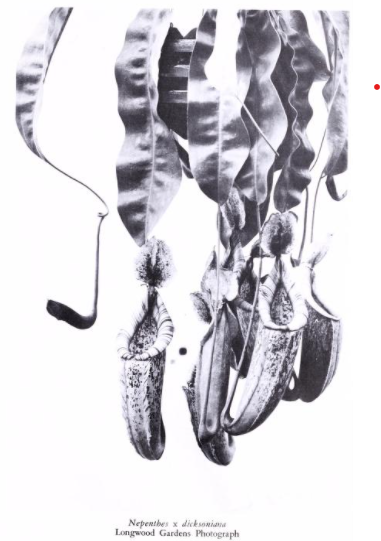
Photograph of N. dicksoniana at the Longwood Gardens in the March 1979 Carnivorous Plant Newsletter. The influence of N. x dicksoniana is very heavily apparent in N. x Dyeriana!
|
"Nepenthes x dicksoniana, offered in 1889, is the offspring of N. rafflesiana flowering in the Botanic Gardens at Edinburgh, fertilized by pollen of N. veitchii sent from Chelsea. Mr. Lindsay, late Curator of the Edinbrugh Botanic Gardens, effected the cross, and in deference to his wish the seedling bears the name of the Proefssor Dickson, formerly Professor of Botany at the University. The pitchers of the hybrid are fully 10 in. long, sub-cylindric, of a light fulvous green, densely spotted and speckled with bright crimson.
|
It remains a mystery to me how we modern growers settled on the name N. x Dyeriana, when early publications consistently refer to it by "Sir William Thiselton Dyer" and other possible names. Maybe it was shortened at some point to streamline the name process when it was used for further hybridization. Another mystery is the persistent myth that N. x Dyeriana is sterile. N. x Dyeriana is listed as the pollen parent for many early registered Nepenthes crosses, many of them made and circulated in Japan. Maybe the sterility issues in some individuals came later? The plant did just turn 120 years old!
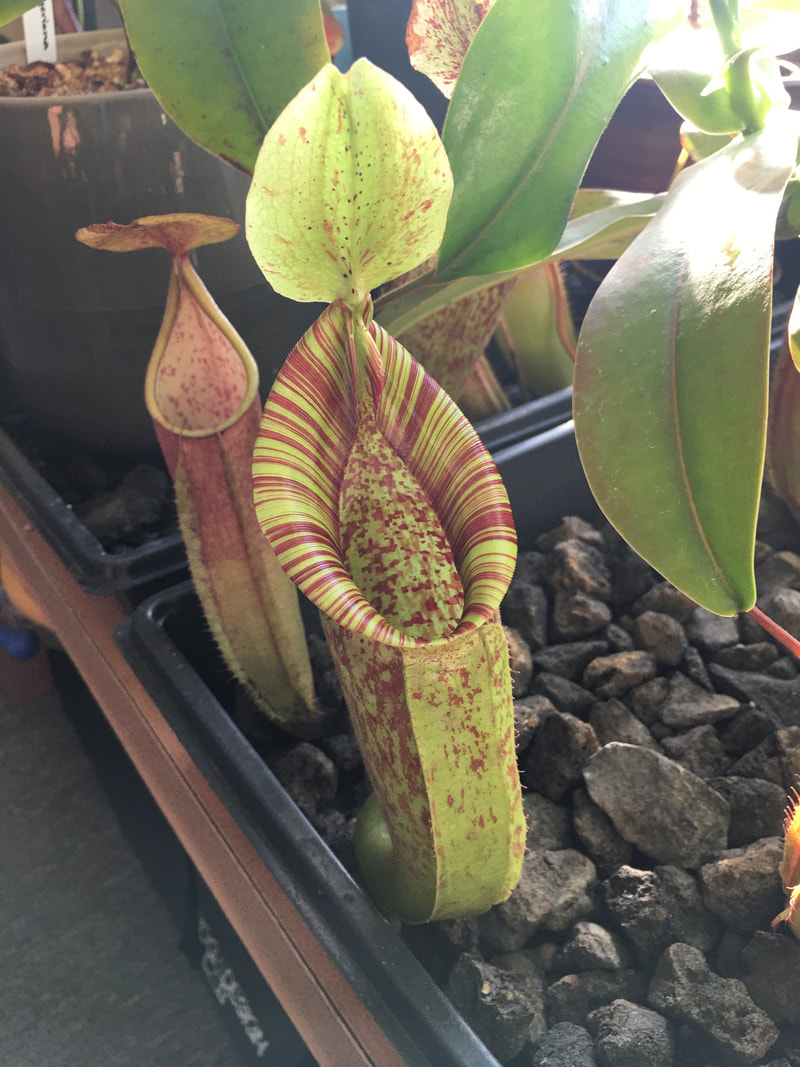
Slightly smaller pitcher because I re-potted it while it was developing, but just as colorful! November 2020
|
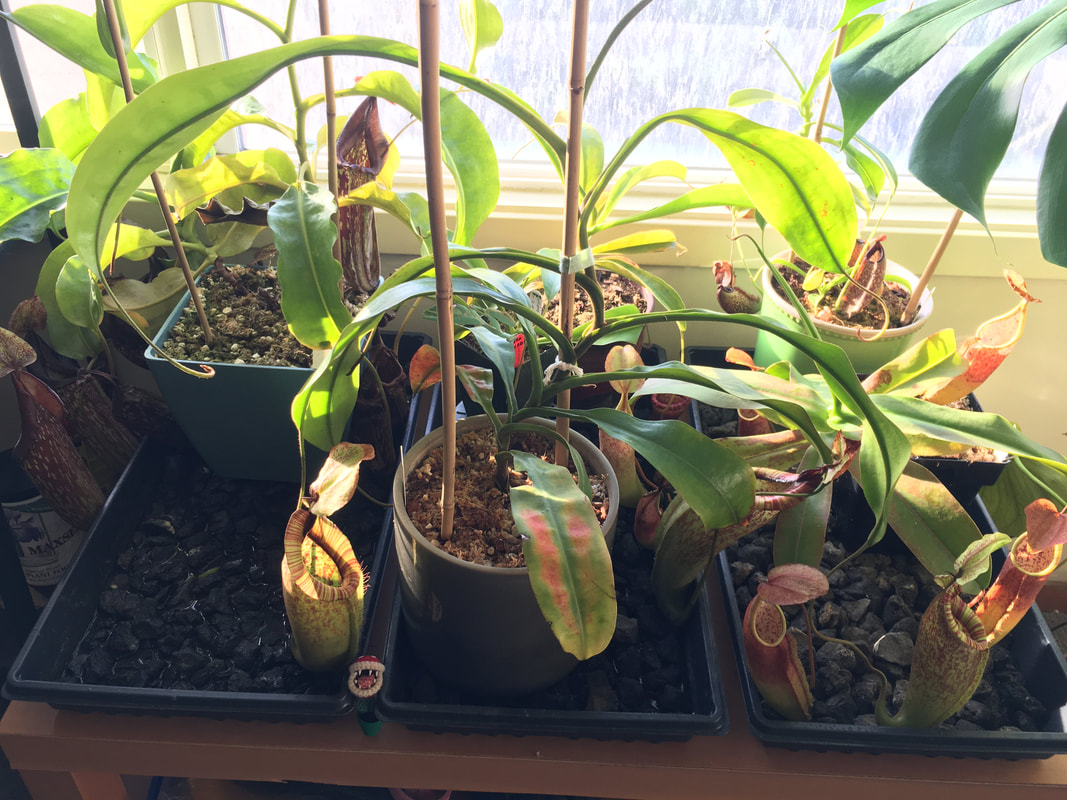
Getting bigger! Can you find my pet praying African mantis hanging out in this photo? She loves hanging out on this plant :) November 2020
|
Honestly I find the history of early Victorian hybrids fascinating. Every time I look at my N. x Dyeriana, I feel a certain kinship to those early Nepenthes growers. It certainly was an exciting time for tropical plant enthusiasts! N. x Dyeriana probably played a huge role in popularizing the cultivation and further hybridization of early Nepenthes when it won the gold medal at the 1900 Chelsea Flower Show.
Despite its lowland ancestry, N. x Dyeriana is an incredibly hardy and vigorous plant on the windowsill. Good thing, too, because this thing is ENORMOUS. I received mine as a large rooted cutting from a fellow hobbyist in November 2019. Although the plant suffered a little bit of damage during shipping, it acclimated relatively quickly to my south facing living room windowsill and started pumping out new leaves and gigantic upper pitchers. Each pitcher is easily 15 inches long! The leaves are extremely long - not including the tendril, a single leaf on my plant averages a solid 13 inches. Nepenthes Around the House has some excellent pictures of a mature N. x Dyeriana hitting his bedroom ceiling!
Some interesting things I have noticed - the leaves on this plant don't readily redden up at all in high light and it doesn't appreciate bright direct light. It will suffer sunburn if kept too close to a bright window. I have mine pulled about 2 feet back from the window and shaded by another Nepenthes. This seems to be the ideal light intensity for healthy leaves and vigorous pitchering. The pitcher walls are also relatively thin (probably due to its lowland parentage) and although it grows and pitchers well in household conditions, the pitchers do no stay in pristine condition for very long. Pitcher longevity might be improved in higher humidity conditions.
Some interesting things I have noticed - the leaves on this plant don't readily redden up at all in high light and it doesn't appreciate bright direct light. It will suffer sunburn if kept too close to a bright window. I have mine pulled about 2 feet back from the window and shaded by another Nepenthes. This seems to be the ideal light intensity for healthy leaves and vigorous pitchering. The pitcher walls are also relatively thin (probably due to its lowland parentage) and although it grows and pitchers well in household conditions, the pitchers do no stay in pristine condition for very long. Pitcher longevity might be improved in higher humidity conditions.
Current Growing Conditions: South-Facing Living Room Window
Light: ~260 - 460 PPFD or 16530 - 20110 Lux (depends on the weather outside)
- Leaves don't develop reddish tones in high light and can sunburn easily
Humidity: ~80% night and 55% day
- Higher humidity may help keep thin walled pitchers active for longer
Temperature: ~68F night and 90F day (depends on weather outside)
Water: Moist but not wet
Potting Mix: 100% long fibered sphagnum
- Noticing some sliminess and compaction - will switch to airier media next repot.
Fertilizer: MaxSea (1/4 tsp/gallon) every other week into pitchers and lightly spray leaves
Additional Notes: Available only through rooted cuttings. Other growers of N. x Dyeriana say that basal shoots and lower pitchers are rare, but plant produces many offshoots off the main stem. Apparently cuttings root easily in water. This is a VERY large plant, minimum diameter is over 2 feet!
Light: ~260 - 460 PPFD or 16530 - 20110 Lux (depends on the weather outside)
- Leaves don't develop reddish tones in high light and can sunburn easily
Humidity: ~80% night and 55% day
- Higher humidity may help keep thin walled pitchers active for longer
Temperature: ~68F night and 90F day (depends on weather outside)
Water: Moist but not wet
Potting Mix: 100% long fibered sphagnum
- Noticing some sliminess and compaction - will switch to airier media next repot.
Fertilizer: MaxSea (1/4 tsp/gallon) every other week into pitchers and lightly spray leaves
Additional Notes: Available only through rooted cuttings. Other growers of N. x Dyeriana say that basal shoots and lower pitchers are rare, but plant produces many offshoots off the main stem. Apparently cuttings root easily in water. This is a VERY large plant, minimum diameter is over 2 feet!